


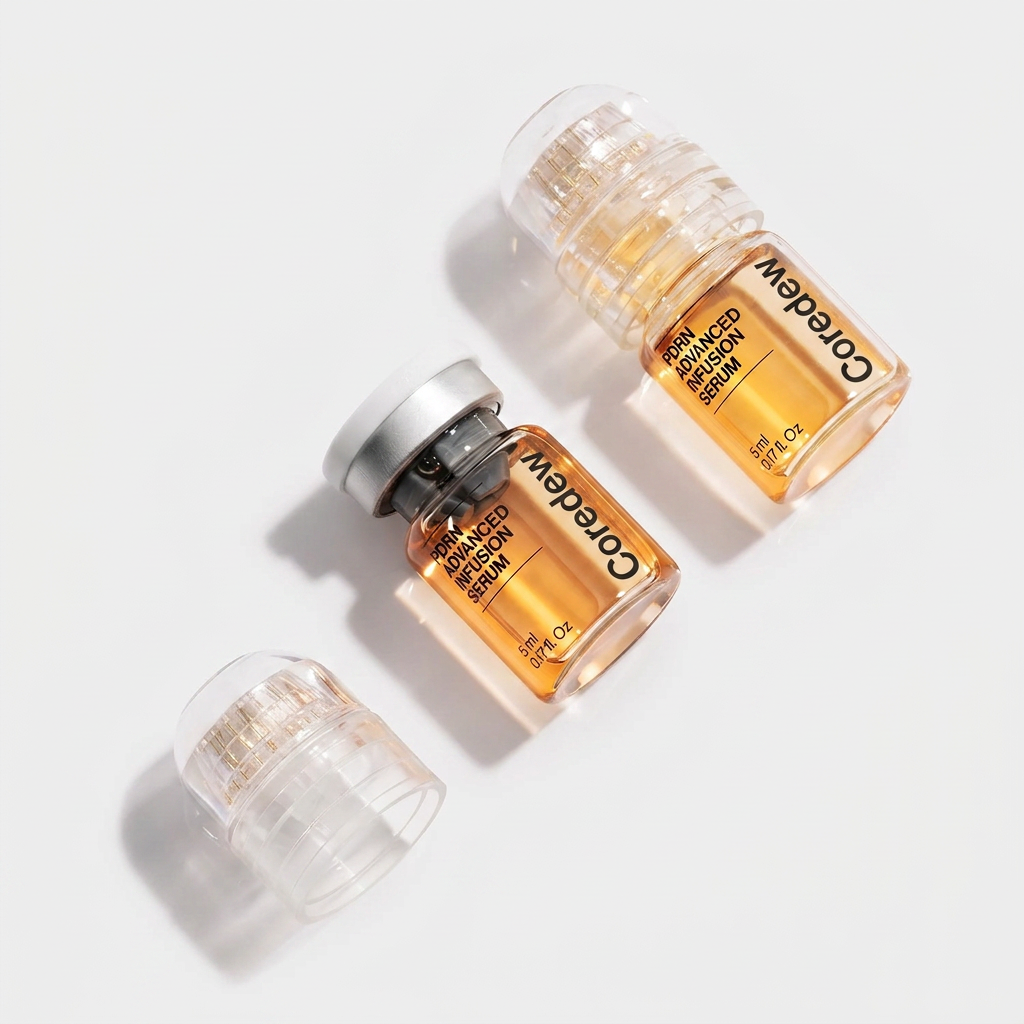
PDRN Advanced Infusion Treatment
PDRN Advanced Infusion Treatment
Visibly smooth acne scars and reclaim your confidence with just 5 minutes, twice a month.
BUNDLE & SAVE
Couldn't load pickup availability

PDRN Advanced Infusion Treatment
What is PDRN (Salmon DNA)?
PDRN (Polydeoxyribonucleotide) is a powerful skin‑repairing compound derived from salmon DNA.
With proven regenerative and anti‑inflammatory properties, it has been widely used in Korean aesthetic clinics for years, primarily for wound healing, post‑surgical recovery, and advanced skin rejuvenation treatments.
PDRN is known for its ability to:
- Stimulate fibroblasts (the cells that produce collagen)
- Improve tissue regeneration
- Calm inflammation
- Accelerate healing from within
We are proud to be one of the first to make this clinically‑proven ingredient available as an at‑home micro‑infusion treatment, so you can get the benefits without the clinic hassle.
How often should I use it?
Just 5 minutes twice a month. Each treatment uses 1 vial and 1 sterile needle head.
Every order comes with a step‑by‑step video guide and instructions.
Ingredients
Designed specifically for post‑acne skin, our advanced PDRN formula combines regenerative growth factors, peptides, and soothing actives to support skin repair, improve texture, and restore a healthier‑looking complexion. Here are the key ingredients that make the difference:
- PDRN (Salmon DNA): Stimulates skin regeneration and collagen synthesis
- EGF (Oligopeptide‑1): A powerful growth factor that supports skin renewal for smoother, healthier‑looking skin.
- Peptide Complex: Supports collagen production to help improve the look of acne scars and uneven texture
- Centella Asiatica + Madecassoside: Calms visible redness and supports the skin's natural healing process
- Beta‑Glucan & Hyaluronic Acid: Provide deep hydration while helping strengthen the skin barrier
Note: Due to the natural properties of the formula, serum color may vary slightly or fade over time. This does not affect its safety or effectiveness.
All ingredients: Water, Glycerin, Butylene Glycol, Panthenol, Trehalose, 1,2‑Hexanediol, Hydroxyacetophenone, Niacinamide, Cyclodextrin, Centella Asiatica Extract, Sodium DNA (Salmon DNA), Beta‑Glucan, Xanthan Gum, Allantoin, Madecassoside, Gentiana Scabra Root Extract, Sodium Hyaluronate, Polysorbate 20, Centella Asiatica Leaf Extract, Carbomer, Sodium Lactate, Asiaticoside, Gardenia Florida Flower Extract, Phellodendron Amurense Bark Extract, Caprylyl Glycol, Palmitoyl Tripeptide‑8, Palmitoyl Tripeptide‑1, Oligopeptide‑1, Heptapeptide‑6, Acetyl Heptapeptide‑4, Palmitoyl Tetrapeptide‑7
How long until I see results?
Most customers notice smoother, more hydrated skin within 24–48 hours of the first treatment. Real texture change starts around weeks 4–6 (treatments 2–3). Deeper scars begin to fill from underneath at weeks 8–12 (treatments 4–6) — that's when most people say the change became undeniable. Mild‑to‑moderate scars usually respond fully within the 6‑treatment protocol; deeper or older scars do best with the longer 5‑month plan.
Will it work on my deep or older scars?
Yes — the mechanism is identical whether your scars are two years old or twenty. The fibroblasts that rebuild collagen are still alive in old scars; they've just had no signal to act. What changes with deeper or decades‑old scars is the dosing: plan for the 10‑treatment (5‑month) course instead of the 6‑treatment protocol, and expect change to build gradually between months 3 and 5.
Are the results permanent, or do they fade?
The collagen your skin rebuilds is a structural change — new tissue filling depth that was empty before. It's not a coating that washes off or a filler that drains away. The improvement holds; what continues over time is normal aging and any new breakouts. Most customers move to a light monthly maintenance rhythm to stay ahead of new damage.
Is it painless and safe for sensitive skin?
The 0.5mm gold‑tipped stamp is virtually painless — most customers describe it as a light tingle, nothing more. The serum is fragrance‑free, alcohol‑free and designed for sensitive, post‑acne skin.
90‑day guarantee, shipping & returns
Every order is covered by a 90‑day money‑back guarantee — complete the protocol, and if you don't see a visible difference, email support@thedrmlab.com and we'll refund every penny.
Free shipping; we process orders in 1–2 business days, with delivery typically taking 5–12 days.




Why Nothing Has Your Scars
When acne inflamed your skin, it destroyed collagen deep in the upper dermis. It left actual holes in the structure of your skin. That's why you see indentations: ice pick, boxcar, rolling scars.
Here's the problem nobody explains: every cream, serum and oil you've ever applied sits on the surface — the epidermis — because intact skin is a sealed barrier that blocks almost everything from getting through. It physically cannot reach the damage. It's like trying to fix a pothole by painting over it.
How the Salmon DNA Infusion System solves this:
Open the path
The 24K gold stamp's ultra-fine 0.5mm needles open microscopic channels through the epidermis — painlessly breaching the barrier that normally blocks ~99% of what you apply.
Deliver the repair crew
With the barrier open, PDRN, growth factors, peptides and Centella Asiatica diffuse down into the dermis far better than they ever could through intact skin — reaching the layer where the collagen was destroyed.
Rebuild from within
Over the next 14 days, those actives wake up the cells that rebuild collagen. New tissue forms inside the scar — filling the hole instead of painting over it. Then you do it again. Each treatment builds on the last.
You were never doing too little. It just never reached deep enough.
Once the barrier is open, serum is absorbed up to 30× better than topical application.
The Korean Clinic Secret Most People Haven't Heard Of Yet
PDRN stands for polydeoxyribonucleotide — fragments of DNA purified from salmon. It sounds exotic, but it's been used in clinical wound-healing and post-procedure recovery for years, and it's one of the most in-demand ingredients in Korean aesthetic medicine.
What makes it matter for scars: PDRN doesn't just sit there. It's studied for waking up fibroblasts — the cells that produce collagen — and calming the inflammation that keeps a scar locked in place. In plain terms, it gives your skin the signal to rebuild the structure acne destroyed.
The catch has always been getting it deep enough. In a clinic that means injections or professional microneedling costing hundreds of dollars per visit. Micro-infusion is what makes a home version possible: open the barrier, deliver the PDRN, let your skin do the rest.
What to Expect, Treatment by Treatment
Scar repair is gradual on purpose — you're rebuilding tissue, not bleaching a stain. Here's the honest timeline.
The first treatment
Five minutes. A light tingle, maybe faint pinkness for an hour. Skin feels plumper that night as it holds the serum.

Texture starts to shift
After treatments 2–3, the shallow stuff softens first. Makeup sits better. You notice it in certain light before anyone else does.

The change others notice
Around treatments 4–6, deeper scars begin to fill from underneath. This is where most people say it became undeniable.

It keeps working
Collagen remodeling continues for weeks after your last session. Deep, raised, or decades‑old scars typically need the longer 5‑month plan — which is exactly why that plan exists.

For mild‑to‑moderate scars, the full repair protocol is 6 treatments — and it fits entirely inside the 90‑day money‑back window, so you can judge the results before you commit. Deeper or older scars do best with the 5‑month plan.
"I've Done Lasers and Professional Microneedling. Why Would This Work?"
Fair question — and if you've spent thousands at clinics, you've earned the right to ask it. Here's the honest answer.
Most aggressive treatments work by injuring the skin and hoping the healing response fills the scar. Sometimes it does. Often it stops short, because injury alone doesn't guarantee your fibroblasts rebuild collagen where you need it — and on deeper skin tones, that injury can trigger pigmentation instead.
This works differently. The micro-channels are just the delivery route. The actual repair signal comes from the PDRN and growth factors reaching the dermis and telling your cells to rebuild — consistently, every two weeks, without trauma.
It's the difference between one violent attempt to force a result — and patiently giving your skin the signal to rebuild itself, layer by layer.
"I did three rounds of Fraxel and a year of in-office microneedling. This is the first thing that kept improving my cheeks after I stopped paying someone else to do it."
— Joe, verified customer, boxcar & rolling scars · Verified
Yes — Even Scars You've Had for
One of the most common worries we hear: "Mine are too old. I've had them since high school." Here's the thing about that.
A scar isn't dead tissue — it's living skin that healed into the wrong structure and then stalled. The fibroblasts that could rebuild it are still there. They've just had no reason, and no raw material, to start. Age doesn't close that door; nothing had ever knocked on it.
Deeper, older scars may simply need more treatments than a fresh one — that's the only difference. The mechanism is identical whether the scar is two years old or twenty.
And once your skin rebuilds that collagen, the change is structural — it's new tissue, not a temporary filler that drains away. The improvement holds; what changes over the years is normal aging, which is why some people do occasional maintenance.
Your scars being old doesn't mean they're permanent. It means nothing has reached them yet.
Find Someone With Your Scars
Real customers, real results. Tap your scar type to see results from people who started where you are.

Deep, narrow "punctures"
— Katie H."These are the ones every facialist told me were impossible without a punch excision. They're not gone, but they're shallower and I stopped wearing full-coverage foundation."
- The hardest type — expect to need the deeper protocols
- PDRN rebuilds from the base of the channel upward
- Visible smoothing typically after ~5 months of consistent use

Wide depressions with sharp edges
— Nichole H."Four years of trying things. After my second treatment a friend said my skin looked 'different somehow.' By month three she asked what I was using."
- Edges soften first, then the floor of the scar lifts
- Responds well to consistent bi-weekly treatment
- Most see change between months 2 and 3

Wavy, shadowy undulations
— Ulisse G."It was the shadows that wrecked me — my skin looked dirty in every photo. That's what changed first. The rolling texture just… settled."
- Often the most responsive type to collagen rebuilding
- The light-catching shadows fade as the dermis plumps
- Surface smoothing usually visible by week 8

Flat dark or red marks
— Ella I."In less than 2 months and I took a selfie with no filter for the first time since I was 20. My mum cried when I showed her the before and after."
- Niacinamide + PDRN even out tone as texture improves
- Usually the fastest scar type to show visible change
- Most customers see tone shift within the first 4 weeks
Different scars, same mechanism: reach the upper dermis, signal the repair, repeat. This includes marks and indentations left by picking or popping — same depressed-tissue problem, same rebuild. Most people have a mix of types — the system works on all of them at once.
The Numbers — and Where They Come From
We'd rather show you the source than a stat with no context.
Approved by a Certified Dermatologist

"As a dermatology professional, I highly recommend THE DRM LAB™ PDRN Micro-Infusion Treatment. The Salmon DNA formula delivers visible skin regeneration and barrier support — a results-driven treatment suitable for advanced skincare routines."Dr. Elena Dinkollari · Certified Dermatologist
Inside Our FDA-Registered, GMP-Certified Production Facility
Our PDRN Micro-Infusion System is produced in an FDA-registered, GMP-certified facility using clean, controlled, and automated manufacturing processes. Every batch is tested to ensure safety, sterility, and consistent quality.
Every Ingredient Has a Job. Here's What Each One Does.
This isn't a kitchen‑sink formula. Each active was chosen for one reason: to help your skin rebuild scarred tissue once it reaches the dermis.
PDRN (Sodium DNA — Salmon DNA)
What it does: Wakes up fibroblasts — the cells that produce collagen — and signals your skin to regenerate tissue and calm inflammation.
Polydeoxyribonucleotide has been used in clinical wound‑healing for years; it's studied for activating the repair pathway that drives new collagen synthesis.
EGF (Oligopeptide‑1)
What it does: Drives skin‑cell renewal, helping fresh, healthier tissue replace damaged surface cells for smoother texture.
Epidermal Growth Factor is one of the most‑researched signaling proteins in skin repair — it tells skin cells to proliferate during healing.
Peptide Complex
What it does: Supports collagen production to help fill scar depth and even out uneven texture over repeated treatments.
Signal peptides are studied for prompting the dermal matrix to produce more collagen and elastin.
Centella Asiatica + Madecassoside
What it does: Calms the redness and inflammation that micro‑infusion can briefly trigger, and supports the skin's own healing response.
"Cica" is one of the most‑studied botanicals for wound healing and barrier repair, valued for its anti‑inflammatory triterpenes.
Niacinamide
What it does: Evens out the discoloration and post‑acne marks that often shadow a scar, while strengthening the skin barrier.
Vitamin B3 is widely studied for improving uneven tone, supporting the barrier, and regulating oil.
Beta‑Glucan + Hyaluronic Acid
What it does: Floods the freshly‑opened channels with deep hydration and helps plump and soothe skin while it repairs.
Both are studied humectants; hyaluronic acid holds many times its weight in water, beta‑glucan supports barrier recovery.
View full ingredients list
Water, Glycerin, Butylene Glycol, Panthenol, Trehalose, 1,2‑Hexanediol, Hydroxyacetophenone, Niacinamide, Cyclodextrin, Centella Asiatica Extract, Sodium DNA (Salmon DNA), Beta‑Glucan, Xanthan Gum, Allantoin, Madecassoside, Gentiana Scabra Root Extract, Sodium Hyaluronate, Polysorbate 20, Centella Asiatica Leaf Extract, Carbomer, Sodium Lactate, Asiaticoside, Gardenia Florida Flower Extract, Phellodendron Amurense Bark Extract, Caprylyl Glycol, Palmitoyl Tripeptide‑8, Palmitoyl Tripeptide‑1, Oligopeptide‑1, Heptapeptide‑6, Acetyl Heptapeptide‑4, Palmitoyl Tetrapeptide‑7
Fragrance‑free, alcohol‑free, non‑comedogenic, cruelty‑free. Ingredient research describes how these actives work in skin generally and is not a claim that this product treats any medical condition.
Every Ingredient Has a Job. Here's What Each One Does.
This isn't a kitchen‑sink formula. Each active was chosen for one reason: to help your skin rebuild scarred tissue once it reaches the dermis.
PDRN (Sodium DNA — Salmon DNA)
What it does: Wakes up fibroblasts — the cells that produce collagen — and signals your skin to regenerate tissue and calm inflammation.
Polydeoxyribonucleotide has been used in clinical wound‑healing for years; it's studied for activating the repair pathway that drives new collagen synthesis.
EGF (Oligopeptide‑1)
What it does: Drives skin‑cell renewal, helping fresh, healthier tissue replace damaged surface cells for smoother texture.
Epidermal Growth Factor is one of the most‑researched signaling proteins in skin repair — it tells skin cells to proliferate during healing.
Peptide Complex
What it does: Supports collagen production to help fill scar depth and even out uneven texture over repeated treatments.
Signal peptides are studied for prompting the dermal matrix to produce more collagen and elastin.
Centella Asiatica + Madecassoside
What it does: Calms the redness and inflammation that micro‑infusion can briefly trigger, and supports the skin's own healing response.
"Cica" is one of the most‑studied botanicals for wound healing and barrier repair, valued for its anti‑inflammatory triterpenes.
Niacinamide
What it does: Evens out the discoloration and post‑acne marks that often shadow a scar, while strengthening the skin barrier.
Vitamin B3 is widely studied for improving uneven tone, supporting the barrier, and regulating oil.
Beta‑Glucan + Hyaluronic Acid
What it does: Floods the freshly‑opened channels with deep hydration and helps plump and soothe skin while it repairs.
Both are studied humectants; hyaluronic acid holds many times its weight in water, beta‑glucan supports barrier recovery.
View full ingredients list
Water, Glycerin, Butylene Glycol, Panthenol, Trehalose, 1,2‑Hexanediol, Hydroxyacetophenone, Niacinamide, Cyclodextrin, Centella Asiatica Extract, Sodium DNA (Salmon DNA), Beta‑Glucan, Xanthan Gum, Allantoin, Madecassoside, Gentiana Scabra Root Extract, Sodium Hyaluronate, Polysorbate 20, Centella Asiatica Leaf Extract, Carbomer, Sodium Lactate, Asiaticoside, Gardenia Florida Flower Extract, Phellodendron Amurense Bark Extract, Caprylyl Glycol, Palmitoyl Tripeptide‑8, Palmitoyl Tripeptide‑1, Oligopeptide‑1, Heptapeptide‑6, Acetyl Heptapeptide‑4, Palmitoyl Tetrapeptide‑7
Fragrance‑free, alcohol‑free, non‑comedogenic, cruelty‑free. Ingredient research describes how these actives work in skin generally and is not a claim that this product treats any medical condition.
Your Treatment Night, Start to Finish
Five minutes, once every two weeks. That's the whole commitment.

1 · Cleanse & dry
Wash your face and pat dry so the serum makes clean contact. No prep skincare required.

2 · Stamp the serum in
Apply the PDRN serum, then glide the gold stamp over each scarred area. A light tingle, nothing more.

3 · Let it work
Skip actives that night, sleep, and let the channels close on their own. That's it until two weeks later.
That night: nothing else on your skin — let the serum work overnight.
The next morning: SPF is the one non-negotiable — freshly treated skin needs protection.
Next 24h: skip makeup, sun, gym and strong actives (retinol, acids, vitamin C); gentle moisturizer is fine. Mild redness for a few hours is normal — treat on Friday night and you're back to normal well before Monday.
The next 13 days: your regular routine, unchanged. The system replaces nothing — it adds one 5-minute ritual every two weeks.